- Howie Fenton
- |
- October 19, 2026
Most print operations already have data. The challenge is that much of it is not the kind of data AI can use. This is the second article in a three-part series on preparing operations for AI. and it focuses on the job-level data AI needs to move beyond reports and begin identifying problems. patterns. risks. and improvement opportunities.

A monthly report might say the shop completed 1.250 jobs. printed 2.4 million pages. increased color volume. or hit a revenue target. Those numbers matter. They help with reporting. They help show volume. They may even help justify staffing. equipment. or budget decisions.
But they do not explain the workflow. They do not tell you which jobs waited. They do not tell you where they waited. They do not tell you why a job stopped. They do not tell you what caused rework. They do not tell you whether the estimate was accurate. They do not tell you which jobs are likely to be late tomorrow.
AI needs more than a summary number. AI needs the story behind the number. That story lives at the job level. Consider the difference between these two pieces of information. The first is a dashboard number: "We completed 1.250 jobs this month." That is useful. but it hides almost everything AI needs to know.
The second is a job-level event trail: "Job 4567 entered prepress at 9:15. work did not begin until 2:40. proof approval was delayed. the job returned for a file correction. and final delivery was one day late." That second example is much more valuable. It shows the job. the step. the time. the delay. the reason. the rework. and the outcome. With enough records like that. AI can begin to identify patterns. predict risk. and recommend action. That is why job-floor tracking is so important. It creates the event record that turns production activity into usable operational intelligence.
At a minimum. a useful job-floor tracking record should capture the job ID. department or workflow step. start time. end time. status. reason code. operator or device. and actual time or material used. This does not require a perfect system on day one. It requires a consistent system that captures the right information at the right time.
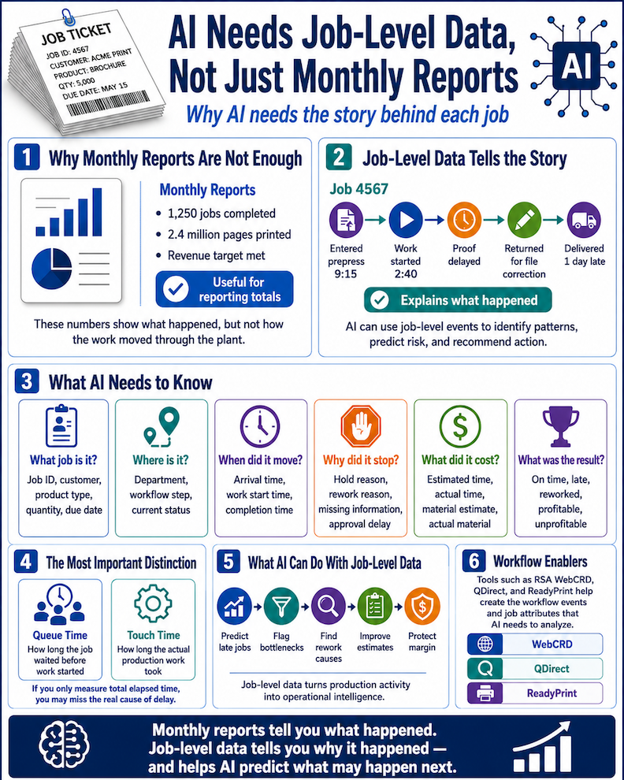
The most important timestamps are the moments when a job enters a step. when work begins. and when the step is completed. These timestamps make it possible to separate queue time from touch time. Queue time is how long the job waited before work started. Touch time is how long the actual production work took. That distinction is critical because many print operations focus heavily on equipment speed. But the biggest workflow problems are often not caused by slow equipment. They are caused by waiting. Jobs wait for files. They wait for proof approvals. They wait for paper. They wait for instructions. They wait for batching. They wait for operators. They wait for equipment availability. They wait because a previous step was done incorrectly and the job has to move backward. If the shop only measures total elapsed time. it may not know whether the real problem is production speed or waiting time.
Job-floor tracking also improves visibility into work-in-process. Managers need to know which jobs are waiting. where they are waiting. how old the queue is. and which jobs are at risk of missing a deadline. A pile of work on a cart may tell you where to look. but it does not tell you how long that work has been waiting or what it is costing.
Measured queue time turns observation into evidence. Reason codes add another layer of value. Timestamps tell us when a job stopped. Reason codes tell us why it stopped. Without reason codes. AI may know a job is late. but it may not know whether the delay came from missing customer files. proof approval. a bad file. a device down. a finishing backlog. a rush job inserted into the schedule. a rework loop. or a delivery issue.
With reason codes. AI can begin to find recurring causes. It may show that customer approval delays are causing late jobs. It may show that certain files repeatedly fail in prepress. It may show that finishing is overloaded after rush jobs are inserted. It may show that a specific job type creates more rework than expected.
This is where RSA's product set becomes highly relevant. WebCRD includes job tracking. alerts. approval steps. and barcode support. QDirect adds centralized control. job routing. batching. load balancing. queue management. and job-ticket management. ReadyPrint supports make-ready. document preparation. and repeatable prepress patterns. These tools do more than move jobs through the workflow. They help create the workflow events and job attributes that AI needs to analyze.
Actual-versus-estimated data is another essential part of AI readiness. If the estimate says a job should take 75 minutes and the actual elapsed time is 180 minutes. managers need to know where the extra 105 minutes came from. Was it prepress queue time? Setup time? Proof approval? Rework? Missing materials? Finishing overload? Delivery delay?
When actual time and material are compared with the estimate. the shop can improve pricing. scheduling. staffing. and production standards. AI can help identify which products are consistently underestimated. which departments create the largest variance. and which job types are eroding margin.
A strong job-level record should help answer these questions:
- What job is it?
- Where is it?
- When did it move?
- Why did it stop?
- How long did it take?
- How does that compare to the estimate?
- Was rework created?
- What did it cost?
- What was the result?
Once those questions are answered consistently. AI can do more than summarize the past. It can help predict late jobs. flag bottlenecks. identify rework causes. recommend staffing changes. improve estimates. and protect margin.
The practical message is simple: AI does not need more monthly reports. It needs clean. structured job-level data that it can analyze.
Monthly reports tell you what happened. Job-level data tells you why it happened. And AI-ready job-level data can help you overcome production issues and predict what may happen next. In the next and final article. we will explore how AI can use job-level data to identify bottlenecks. predict which jobs will take longer. uncover rework causes. compare estimated-versus-actual performance. and recommend practical fixes.