- Howie Fenton
- |
- April 29, 2026
Once you accept that faster cycle time is the new lowest bid, the next question becomes practical: how do you actually build for speed? It is one thing to say customers value faster turnaround. It is another thing entirely to make that turnaround real inside the workflow. If speed is going to become part of the product you sell, then it has to be engineered into the process from the very beginning.
This is where The Goal, by Eliyahu M. Goldratt, gives shops a very useful management lens. The basic idea is simple: identify the constraint, organize the workflow around it, and stop wasting effort optimizing parts of the system that do not determine total output. In print, that means treating the real bottleneck with far more discipline. If approvals are the constraint, speed up approvals. If release readiness is the constraint, tighten release. If scheduling uncertainty is the constraint, stop pretending more press capacity will fix it.
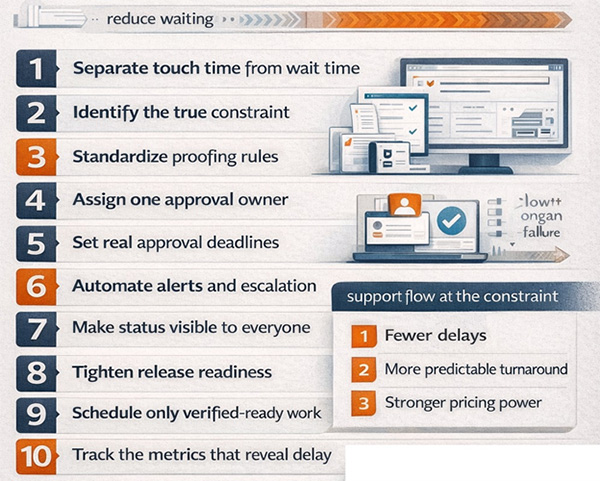
The first step is to separate touch time from wait time. Many shops assume they know where delays are happening, but the numbers often tell a different story. When you look closely, you may find that the real problem is not how long the work takes, but how long it spends waiting for approvals, corrections, missing information, release, or production start. That is an important distinction because it tells you where to focus your energy. You do not improve a waiting problem by simply asking people to work harder. You improve it by finding the true point of constraint and reducing the delay there.

Once that becomes visible, the next priority is reducing unnecessary variation. Proofing slows down when every order is treated like a special case, so faster shops define when a proof is required, who approves it, what that approval actually covers, and what changes trigger another round. The same principle applies to decision-making. Too many reviewers create slow motion, which is why it helps to separate commenters from decision-makers and assign one clear approval owner. Approval windows matter as well. If there is no deadline, delay becomes the default. Tying responses to real production cutoffs makes timing visible and manageable instead of vague and hopeful.
Those steps also reflect another important lesson from The Goal: once you identify a bottleneck, you do not let it starve, and you do not let unnecessary variation clog it. In a print workflow, that means the approval path should be clear, the proofing rules should be standardized, and the release decision should not be buried under avoidable ambiguity. The goal is not simply more activity. The goal is smoother flow through the point that governs total turnaround.
Manual follow-up is another silent drain on cycle time. Too much time gets lost because someone has to keep checking whether an approval came in, send reminders, or escalate because production is waiting. That is why alerts and escalation rules matter. The goal is not simply to reduce clicks. The goal is to reduce uncertainty and stop wasting labor on chasing information the workflow should surface automatically. The same thinking applies to status. Customers and internal teams should not need to interrupt production or prepress just to ask where the job stands. Status needs to be visible enough that people can see the stage, blocker, next step, owner, and timing without creating more noise in the system.
Release discipline is where speed becomes real. "Ready" should never be a vague feeling. It should mean the correct file has been approved, the ticket is complete, specs are confirmed, and the job has been validated to run. Shops also need to stop scheduling on hope. If a job is still waiting on approval or correction, it should not be treated like work that is truly ready for production. Reserving capacity for unready jobs destabilizes the day and turns planning into a reactive exercise. Verified readiness has to matter more than optimism. In Theory of Constraints terms, this is really about subordinating the rest of the workflow to the needs of flow. Work should be released and scheduled in a way that supports the system, not in a way that makes individual departments look busy.
Measurement is what makes all of this sustainable. Shops should track approval turnaround time, proof rounds, approval-to-release time, schedule changes caused by late approvals, and the ratio of wait time to touch time. Those are the metrics that reveal the delays customers never see directly but absolutely feel. They also help answer a very important question from The Goal: is the change increasing throughput, or is it just increasing activity? That is the larger mindset shift behind all of this. Speed is not just an internal goal. It is part of the product. If customers are willing to pay for faster, more predictable delivery, then proofing, approvals, release, scheduling, and visibility all need to be designed with that goal in mind.
This is where the workflow stack plays an important role. RSA's WebCRD helps streamline intake, approvals, alerts, and status. . RSA's ReadyPrint supports make-ready, editing, and automation. RSA's QDirect improves routing, batching, monitoring, and control. Preflight Pro strengthens release readiness. Together, those tools support a workflow that is more disciplined, more visible, and more responsive. But the real value is not the technology itself. The real value is what the technology enables: fewer waiting points, fewer handoff failures, better control of constraints, and a faster, more reliable operating model.
The takeaway is clear. Shops do not win this next phase of competition by simply running presses faster or discounting more aggressively. They win by identifying bottlenecks, reducing waiting, clarifying ownership, tightening release, improving visibility, and creating the kind of reliable speed customers are willing to pay for. That is the real business opportunity. If your workflow can reduce delay and increase certainty, you are not just improving operations. You are increasing the value of what you sell. And in a market where customers are under pressure too, that kind of speed is not just helpful. It is pricing power.