- Howie Fenton
- |
- April 29, 2026
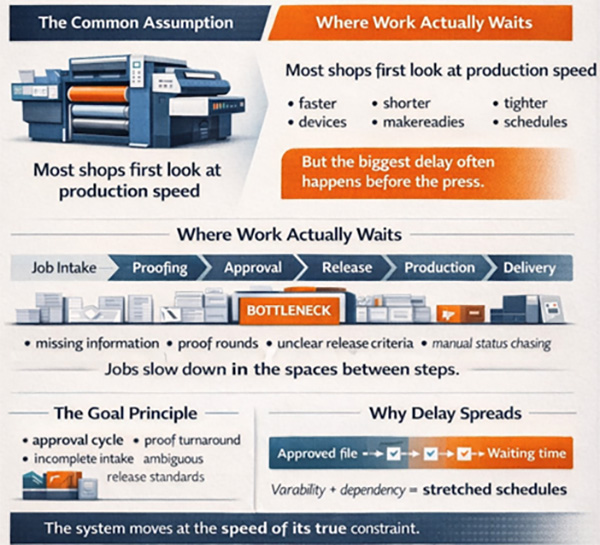
When a shop wants to improve turnaround, the first instinct is usually to look at production. That makes sense. Faster devices, shorter makereadies, tighter schedules, and better throughput all sound like the obvious path to faster delivery. But if you have ever looked closely at how work actually moves through a print operation, you already know that the biggest delays often are not happening on the floor. In many shops, the real drag on cycle time happens before the press ever has a chance to become the bottleneck.
Jobs slow down in the spaces between steps. They wait for approvals, stall in proofing, sit idle while someone looks for missing information, or get hung up because release criteria are not clear. Status gets chased manually. People assume someone else owns the next action. A file may be technically ready to move, but the process around it is not. That is where cycle time gets lost, and it is why many shops feel busy all day without actually moving work through the system as quickly as they should.
This is exactly the kind of issue The Goal, by Eliyahu M. Goldratt, helps explain. One of the book's central lessons is that every system has constraints, and the overall speed of the system is set by those constraints. In print, the constraint is not always the machine. It may be the approval cycle. It may be proof turnaround. It may be incomplete job intake. It may be ambiguous release standards. If work has to pass through that point before it can move on, then that point functions like a bottleneck whether or not it looks like traditional production equipment.

That matters because dependent events are everywhere in print. A job cannot be released until it is approved. It cannot run cleanly until the file is validated. It cannot move confidently into production until ticketing, specs, and finishing details are complete. When one step depends on the one before it, delay accumulates. The Goal makes the point that variability plus dependency causes schedules to stretch more than most managers expect. That is exactly what happens when approvals arrive late, proofs go through too many rounds, or release standards are interpreted differently by different teams. The delay does not stay contained in one department. It ripples through the whole schedule.
Most operations can tell you how long something took to print. Far fewer can tell you how long it waited for approval, how long it lingered between proof and release, or how much time was consumed by internal follow-up. Customers, of course, feel all of that time whether you measure it or not. They do not separate production time from waiting time. They only experience total turnaround. That is why the real issue is often not production capacity. It is decision latency.
This changes the way shops should think about improvement. If the actual problem is waiting, then pushing the production floor harder does not solve it. It only pushes the stress downstream. One of the most useful ideas from The Goal is that balancing capacity is not the same as balancing flow. A non-bottleneck can look fully utilized and still contribute nothing to faster delivery if the real constraint is somewhere else. In fact, trying to maximize utilization everywhere often creates more work-in-process, more queue time, and more confusion.
The waiting points in most shops are not hard to identify once you start looking for them. Proofs sit in review longer than they should. Approvals have no clear deadlines. Schedules are built around hoped-for responses rather than confirmed readiness. Release decisions are delayed because "ready" is interpreted differently by different people. Internal teams spend too much time checking status instead of moving work forward. None of those problems are caused by the printing equipment. They are caused by the way the workflow is governed.
That is why this issue is not just operational. It is commercial. If customers are willing to pay more for speed, then slow approvals, loose proofing practices, weak handoffs, and unclear release criteria are not just process problems. They are margin leaks. Every unnecessary pause weakens your ability to deliver the kind of responsiveness the customer values. In other words, if speed is part of what you are selling, then the workflow around production has to be strong enough to support that promise.
This is also where the workflow software layer becomes important. Tools like . RSA's WebCRD, ReadyPrint, QDirect, and Preflight Pro matter because they help create structure where many shops are still relying on memory, manual follow-up, or case-by-case judgment. Intake, approvals, alerts, tracking, make-ready, routing, batching, monitoring, and validation all help reduce non-production delay before the job ever reaches the device. Used properly, they do not just automate tasks. They help control variability at the constraint points that actually determine cycle time.
The key takeaway here is that faster turnaround is rarely just a pressroom story anymore. In many cases, it is a workflow story. The shops that improve cycle time most successfully are the ones that stop looking only at production speed and start looking at everything that happens before production begins. That is where hidden delay lives, and that is where the real opportunity is. In the final article, I'll break down the practical steps shops can take to reduce that delay and build a workflow that moves faster without burning out the team.