- Howie Fenton
- |
- April 29, 2026
Let's be honest: most print providers are tired of having the same pricing conversation over and over again. A customer gets a quote, compares it to an online source, and immediately pushes back on price. It is a frustrating place to compete because it reduces everything you do to a number on a page. But that conversation is starting to change, and the shift creates a real opportunity for print providers that are paying attention.
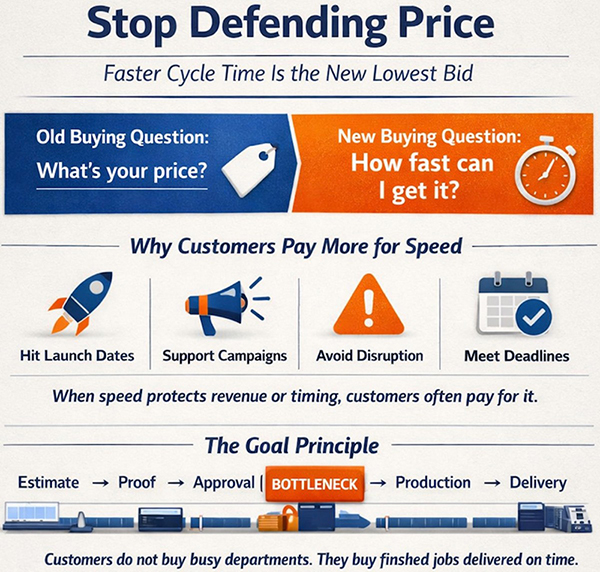
Today, faster cycle time is becoming the new lowest bid. Customers still care about price, but price is no longer the only thing shaping the buying decision. More often now, the first real question is, "How fast can I get it?" When speed helps a customer hit a launch date, support a sales campaign, avoid disruption, or meet a deadline they cannot miss, they are often willing to pay more for that speed. That means turnaround is no longer just an internal measure of efficiency. It is part of the value proposition.
"How fast can I get it?" When speed helps a customer hit a launch date, support a sales campaign, avoid disruption, or meet a deadline they cannot miss.
That idea lines up well with one of the core lessons from The Goal by Eliyahu M. Goldratt: businesses do not win by making every individual part of the operation look busy. They win by improving the flow of work through the whole system. In print, that is an important distinction. A shop can have efficient departments, strong equipment utilization, and people working hard all day, yet still deliver slowly if work is piling up at one constraint point. Customers do not buy departmental efficiency. They buy finished output delivered on time.
That is why speed has real commercial value. Most customers are not thinking about your workflow the way you are. They do not care whether your press is faster than the last one you installed, whether prepress turned the file quickly, or whether your plant is running at high utilization. What they care about is much simpler: when can I have the finished job in hand? If the proof sat untouched for hours, if approvals dragged, or if the job stalled between release and production, the customer does not separate those issues into departments. They experience one thing: elapsed time. That is why cycle time has pricing power. The shorter and more predictable your turnaround is, the more valuable your service becomes.
This is also where The Goal is especially useful. One of its biggest ideas is that improving non-bottlenecks does not necessarily improve total system performance. In other words, making one part of the workflow faster does not help much if the real bottleneck is somewhere else. That matters in print because many shops still think speed is mainly a pressroom issue. But if the real constraint is approvals, proofing, release discipline, or scheduling, then adding capacity on the floor will not solve the customer's real problem. It may improve local productivity, but it will not meaningfully shorten cycle time.
This is also where workflow technology becomes part of the business conversation, not just the production conversation. Tools such as RSA's WebCRD can help structure intake, approvals, job tracking, alerts, and customer visibility. RSA's ReadyPrint helps support faster make-ready, late-stage edits, and file preparation, while RSA's QDirect helps with routing, batching, monitoring, and job control. RSA's Preflight Pro helps strengthen file readiness before work reaches production. When shops use tools like these to reduce friction around approvals, file preparation, release, and handoffs, they are doing exactly what The Goal argues for: improving flow through the real constraints instead of simply making isolated parts of the process look faster.

That is a powerful shift in perspective because it changes the basis of competition. The old assumption was that if you wanted more business, you had to lower price. A better question now is whether your workflow allows you to sell speed with confidence. If you can reduce delay, tighten handoffs, and improve flow through the true constraints in the process, you are offering something many customers value more than a small cost difference. That changes the conversation from "How do we match the cheapest number?" to "How do we create enough speed and certainty that customers will pay for it?" That is a stronger position, a healthier position, and ultimately a more profitable one.
The bigger takeaway is simple: speed is no longer just an operations issue. It is also a sales, workflow, and margin issue. Shops that continue competing only on price will stay stuck defending quotes. Shops that learn how to identify constraints, improve flow, and support that speed with the right workflow tools will have a better story to tell and a better reason to win. In the next article, I'll focus on where that speed is really being lost, because in most shops the biggest delay is no longer the press. It is what happens between steps.