- Howie Fenton
- |
- October 07, 2026
As I prepare a new series of presentations on how operations should prepare for future AI tools, I keep coming back to one central challenge: we need to change the way we think about metrics. For years, we have measured activity — pages printed, jobs completed, clicks, impressions, and monthly volume. Those numbers are useful, but they are not enough for AI. To take advantage of the next generation of AI tools, printers will need metrics that are more actionable, more detailed, and more closely tied to how work actually moves through the operation. This is the first article in a three-part series on preparing print operations for AI, and it explains why the shift from activity metrics to actionable metrics is the foundation for everything that follows.
Most print operations are not short on data. They know how many pages they printed. They know how many jobs were completed. They know how many clicks ran through the digital presses. They know monthly volume, revenue, and sometimes even cost-per-click.

The problem is that most of the data printers already collect only tells them what happened. It does not tell them why a job was late. It does not tell them where work sat for three hours. It does not tell them why a job came back for rework. It does not tell them whether a job made money or only looked profitable on the estimate. That difference — between numbers that report activity and numbers that explain performance — is becoming one of the most important issues in print operations. It is also the first step in preparing for AI. AI will not improve print production unless it has the right data. And the right data starts with better metrics.
The pressure on print operations has changed. Budgets are tighter. Staffing remains constrained. Customers expect faster turnaround, better communication, and fewer surprises. Senior leaders want proof before approving software, equipment, staffing, or workflow redesign. Margins are under pressure, and managers need to know whether the operation is truly productive or simply busy. That is why metrics matter more now.
For many years, print shops focused on activity metrics. These include pages printed, jobs completed, impressions, clicks, and monthly volume. Those numbers are easy to collect and useful for reports, but they rarely tell managers what to fix. A shop can produce more pages and still lose money if rework is increasing, estimates are wrong, jobs are sitting too long between steps, or bottlenecks are consuming capacity. That is why the next generation of metrics must be actionable.
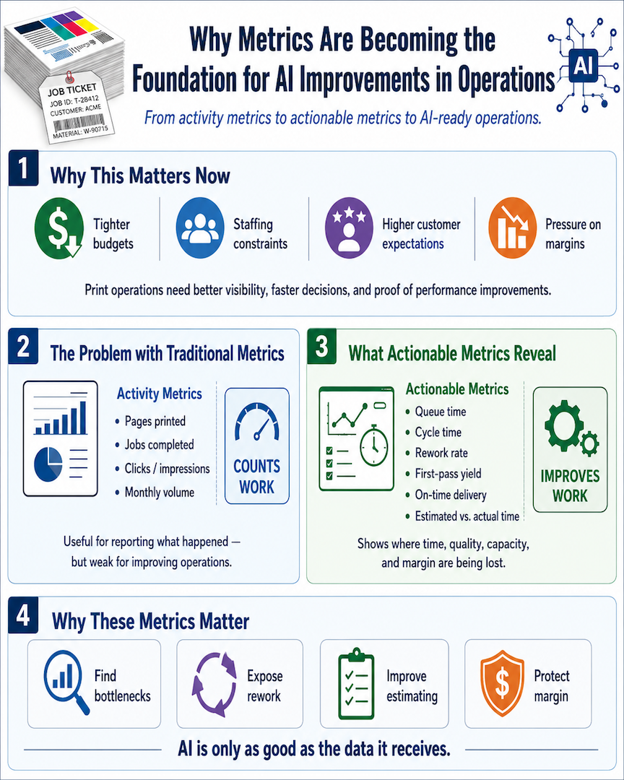
Actionable metrics are the measures that help managers make decisions. These include queue time, cycle time, rework rate, first-pass yield, on-time delivery, equipment uptime, spoilage, and estimated-versus-actual performance. These metrics expose where time, quality, capacity, and margin are being lost.
Queue time, for example, shows where jobs wait before work begins. That matters because many production delays are not caused by slow presses or slow printers. They are caused by waiting — waiting for proof approval, waiting for paper, waiting for files, waiting for instructions, waiting for staff, waiting for finishing, or waiting because a job came back for rework. If queue time is not measured, managers may blame the wrong part of the process.
Rework is another critical metric. Rework is dangerous because it hides inside the appearance of productivity. The shop looks busy. Equipment is running. Staff are working. Jobs are moving. But some of that activity is repeat work that should not have been necessary. Every remake, correction, or return to a previous step consumes labor, machine time, materials, and schedule capacity.
Estimated-versus-actual time (performance) is equally important because it connects production to profitability. If a job was estimated to take 45 minutes but actually takes 90 minutes, the shop needs to know why. Was the estimate wrong? Was the job more complex than expected? Did the operator wait for information? Did rework occur? Was the job routed to the wrong device? Without actual production data, the shop may continue underpricing work without realizing where the margin is leaking.
This is where software platforms such as RSA's WebCRD, QDirect, and ReadyPrint become part of the metrics conversation. RSA's value is not only that it helps automate workflows. Its deeper value is that it helps create a more structured and measurable workflow.
WebCRD can streamline job intake, approvals, customer ordering, and job tracking. QDirect can route jobs intelligently, batch work, balance production loads, and improve equipment utilization. ReadyPrint can simplify make-ready and reduce manual prepress work. Together, these tools help create the consistency needed for better measurement.
That consistency matters because AI is only as good as the data it receives. If the only data available is monthly page volume, revenue, or job count, AI has very little to work with. It may know that the shop completed 1,250 jobs last month, but it will not know which jobs waited, where they waited, why they stopped, whether they were reworked, or whether they made money.
That is why the future of print metrics is not just more dashboards. It is better job-level data. The evolution is straightforward:
- Activity metrics report what happened.
- Actionable metrics show what to improve.
- AI-ready metrics help predict what may go wrong next.
Print operations that build strong measurement discipline today will be better prepared for AI tomorrow. They will have cleaner data, better visibility, more accurate estimating, stronger workflow control, and a clearer understanding of where productivity and margin are being lost.
The shops that move fastest will not simply be the ones that buy AI tools. They will be the ones that already know how work flows, where it waits, where it repeats, and where it costs more than expected.
AI is coming to print operations. But before AI can recommend better decisions, the operation has to measure the right things.
In my next article, we will look at why AI needs more than monthly reports and how job-level data gives AI the operational detail required to identify patterns, risks, and improvement opportunities.