- Howie Fenton
- |
- November 10, 2026
The next evolution in print operations will not be another dashboard. It will be a system that watches the work, spots trouble earlier, explains what is causing the problem, and offers practical ideas for fixing it. This is the third and final article in a three-part series on preparing your print operations for the changes from AI, and it looks ahead to how AI tools will use job-level data to identify production problems, explain likely causes, and recommend practical ways to fix them.
That is where AI will become valuable in production. Not as a buzzword. Not as a magic button. Not as a replacement for experienced managers. But as a tool that helps managers see patterns faster and act quicker to mitigate small problems become missed deadlines, lost margin, and frustrated customers.
For years, print managers have relied on experience, walk-throughs, job-ticket reviews, staff conversations, and end-of-month reports to understand production performance. Those methods still matter. A good manager can learn a lot by walking the floor. But those methods are often reactive. By the time a manager sees a late job, the deadline may already be at risk. By the time a bottleneck is obvious, jobs may already be piled up. By the time rework appears in the numbers, the shop may already have lost capacity and margin.
AI changes the timing.
When AI tools are connected to clean job-level data, they can help identify operational problems earlier and suggest corrective action while there is still time to act. The key requirement is data. AI cannot diagnose workflow problems from page counts alone. It needs job-level information: job ID, product type, workflow step, start time, end time, queue time, touch time, status, reason code, operator, device, estimated time, actual time, rework flag, material usage, and final outcome. Once that data is captured consistently, AI can begin to see patterns that are difficult for people to detect manually.
One of the most important AI use cases will be bottleneck identification. Today, bottlenecks are often identified by looking for piles of work-in-process. That is a useful clue, but it is incomplete. A pile tells you where work is sitting. It does not tell you how long it has been waiting, why it is waiting, how often the problem occurs, or what it is costing.
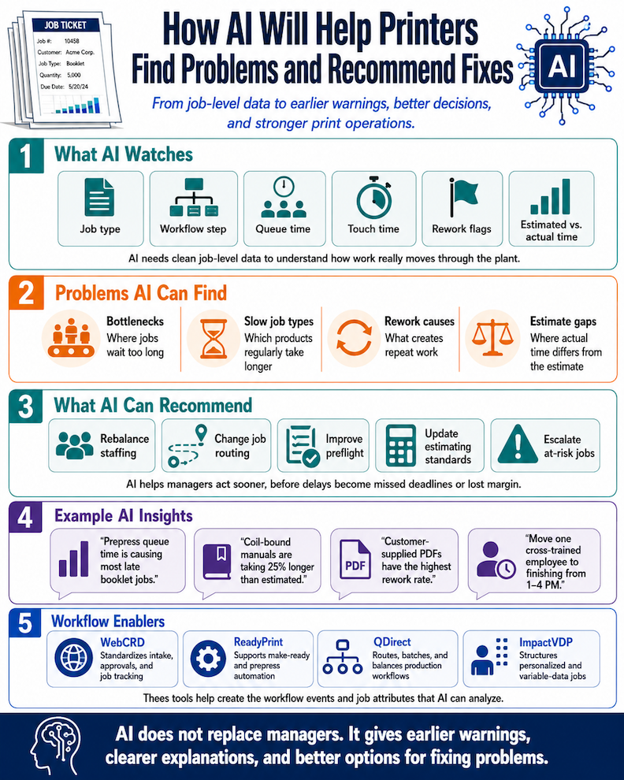
AI can analyze queue time by department, product type, shift, customer, equipment, and job priority. It may show that prepress is the largest source of delay on certain types of jobs. It may show that finishing becomes overloaded every afternoon. It may show that jobs wait too long for proof approval before production can begin. Instead of saying, "We have a bottleneck," AI can help say, "The bottleneck is prepress queue time on customer-supplied PDF booklet jobs, especially when proof approval has increased and requires attention." That is a very different level of insight.
More importantly, AI can recommend possible fixes. If the bottleneck is caused by batching, the recommendation may be to reduce batch size or release jobs more frequently. If the bottleneck is caused by staffing imbalance, the recommendation may be to move a cross-trained employee to finishing during peak hours. If the bottleneck is caused by proof approval delays, the recommendation may be to improve customer communication, automate reminders, or change the approval workflow.
AI will also help identify the types of jobs that are likely to take longer than expected. Every print shop has jobs that look simple in the estimate but routinely take longer in production. These may include short-run booklets, coil-bound manuals, jobs with tabs, customer-supplied PDFs, large-format mounting, variable-data jobs, complex finishing work, or jobs with unusual stocks.

When AI compares job type, quantity, production steps, device, finishing requirements, customer history, and actual production time, it can begin to identify which jobs carry hidden complexity. The system may learn that certain booklet jobs take longer when files come from a specific source. It may learn that wide-format jobs with mounting require more handling time than estimated. It may learn that jobs requiring tabs and coil binding consistently exceed the production standard. That insight can improve scheduling, estimating, pricing, and customer communication. A manager may decide to allow more production time for those jobs, adjust the estimate, change the routing, add a preflight step, or create a different service-level promise.
Rework is another area where AI will become especially valuable. Rework is one of the most expensive forms of hidden waste because it consumes labor, equipment time, materials, and schedule capacity. It also creates additional queue time for other jobs. A shop can look busy while a meaningful percentage of that activity is actually repeat work.
AI can analyze rework by product type, department, operator, device, customer, file source, defect code, and reason code. It may identify that certain customer-supplied files are more likely to fail in prepress, that a specific finishing process produces more defects, or that a particular job type frequently returns for correction after proofing.
The value is not just identifying that rework happened. The value is identifying the likely cause and suggesting a fix. If rework is tied to file problems, the recommendation may be stronger preflight, better customer file instructions, or automated file checks. If rework is tied to equipment setup, the recommendation may be training, maintenance, or a setup checklist. If rework is tied to unclear specifications, the recommendation may be better order-entry prompts or required fields in the job submission process.
This is where workflow tools become essential. RSA’s WebCRD, QDirect, ReadyPrint, and ImpactVDP can play an important role because they help structure the workflow before AI analyzes it. WebCRD supports online job submission, approval workflows, job tracking, alerts, pricing flexibility, barcode support, and production management. That helps standardize the intake process and reduce the vague or incomplete job information that often causes delays later.
ReadyPrint supports make-ready, file preparation, page assembly, imposition, job ticketing, prepress automation, and integration with WebCRD and QDirect. In an AI-enabled environment, that kind of structured prepress workflow matters because many production problems begin before the job reaches the press. If make-ready tasks, file corrections, preflight issues, and automation exceptions are captured consistently, AI can identify which types of files or jobs are most likely to create delays or rework.
QDirect is especially relevant to the future of AI-assisted workflow control. It consolidates, routes, batches, and automates production print workflows. It supports job routing, load balancing, queue management, printer status monitoring, job progress monitoring, job ticketing, and reporting. Those capabilities are directly connected to the kinds of decisions AI will eventually help recommend: which device should run the job, whether jobs should be batched, whether a queue is overloaded, and where work should move next.
ImpactVDP also matters because variable-data and personalized jobs often introduce additional workflow complexity. Personalized print can involve templates, data fields, QR codes, sequential numbering, variable images, and brand-controlled design elements. AI can eventually help identify which VDP jobs are most likely to require additional preparation time, which templates produce the fewest errors, and where personalization workflows need better controls. ImpactVDP helps keep that work structured, repeatable, and in-house instead of relying on manual custom handling.
Another high-value AI use case will be estimate-versus-actual analysis. This may become one of the most important areas where AI helps printers improves your ability to break even financially or increase the contribution back to the parent company. Consultants often say, "The #1 reason I am called is because of a financial issue, such as not breaking even."
If the estimated time for a workflow task is 20 minutes but the actual time is 40 minutes, the shop needs to know why. Was the estimate wrong? Was the job poorly specified? Was the operator waiting for information? Was the equipment down? Did rework occur? Was the job routed to the wrong device? Was the task more complex than the product category assumed?
AI can compare estimated time against actual time by workflow step, product type, customer, quantity, device, operator, shift, and finishing requirement. It can identify where actual performance is consistently longer than estimated. That may point to underpriced work, outdated estimating standards, inefficient procedures, training gaps, equipment constraints, or poor job routing.
AI can also identify the opposite problem: tasks that take less time than estimated. That matters too. If actual time is consistently shorter than estimated, the shop may be overpricing certain work, using old standards, or missing an opportunity to be more competitive. The goal is not always to raise prices. Sometimes the goal is to improve pricing accuracy, scheduling reliability, and customer trust.
Over time, AI could recommend different actions based on the variance. If actual time is longer because of poor estimates, update the estimating standard. If actual time is longer because of rework, fix the root cause. If actual time is longer because of queue time, improve scheduling or staffing. If actual time is shorter, review whether the price is still competitive or whether the production standard should be adjusted.
This is the practical future of AI in print operations. AI will not simply create a prettier report. It will help managers ask better questions:

- Where are jobs waiting?
- Which jobs are likely to be late?
- Which job types take longer than expected?
- Which processes create the most rework?
- Which estimates are wrong?
- Which queues are overloaded?
- Which jobs should be moved, rerouted, batched, or escalated?
- Which process change is most likely to improve performance?
The future of AI-controlled printing operations will not mean removing managers from the process. It will mean giving managers earlier warnings, better explanations, and more specific recommendations. AI may identify the problem, suggest the likely cause, and offer options for fixing it. The manager will still decide which action makes sense based on customer commitments, staffing, cost, equipment, and business priorities.
The practical path forward is to start now. Companies should build a reliable data foundation by tracking queue time, touch time, cycle time, rework, reason codes, WIP aging, on-time delivery, and estimated-versus-actual performance. They should standardize job intake, prepress, routing, job tracking, and production reporting. They should use workflow automation tools to reduce variation and capture cleaner data.
AI will not fix a workflow that the organization cannot measure. But when the data is consistent and actionable, AI can help identify problems faster, explain why they are happening, and recommend practical ways to overcome them. That is the real promise of AI in print operations: not replacing judgment, but giving managers better evidence, earlier warnings, and smarter options before the problem becomes expensive. This is where the future of print operations is headed: not just measuring what happened, but using AI-supported insight to predict problems earlier, recommend better actions, and help managers improve productivity, quality, turnaround time, and margin.