- Howie Fenton
- |
- December 05, 2025
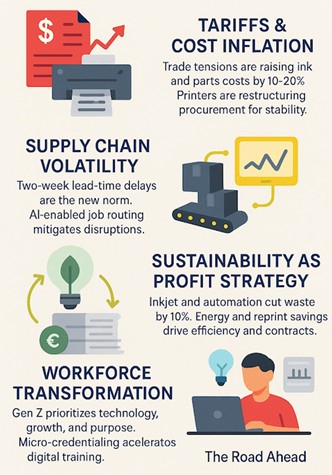
Potential tariffs, supply-chain disruptions, and waning demand for traditional print have created sustained margin pressure and operational uncertainty. This article builds on Part 1, 2026 Print Production Trends, which explored how technology and market shifts are reshaping print production.
Forward-looking printers are no longer treating these forces as temporary crises. Instead, they are transforming them into catalysts for modernization, automation, and sustainable reinvention.
The lessons from 2025 are clear: those who invested in digital workflows, flexible sourcing, and intelligent automation weathered volatility far better than those who clung to legacy models. In the year ahead, resilience will not be defined by cost-cutting alone but by strategic agility—the ability to adapt pricing, production, and customer engagement dynamically in an unpredictable environment.
Tariffs and Import Cost Inflation
Unless the Supreme Court takes action, tariffs continue to reshape procurement decisions across the printing ecosystem. With ongoing trade tensions and component shortages, printers are facing cost increases of 10–20% for imported inks, toners, and equipment parts. Printers are building tariff-resilient supply chains. PwC's 2025 Operations Survey found that 91% of leaders are restructuring procurement for cost stability through regional sourcing, supplier diversification, and long-term contracts with escalation clauses.
According to PRINTING United Alliance's State of the Industry Report (2025), 73% of printers report flat or declining profits due to tariff-related cost increases, and nearly 60% have delayed capital investments. Industry economists, Andy Paparozzi and Marco Boer, caution that hesitation can be costly—delaying modernization may leave companies unable to participate when the market rebounds. Instead, they recommend investing in automation and productivity improvements now to emerge stronger as tariff conditions stabilize. The message is clear: cost volatility is here to stay, and investment timing—not avoidance—is the competitive differentiator.
What This Means for Printers:
Tariffs may become a permanent variable. Printers must evaluate vendors on delivery reliability and total cost of ownership—not just price—and embed tariff modeling into their RFPs and MIS analytics.
Supply Chain Volatility and Predictive Operations
Supply disruptions have become routine, extending lead times by two to three weeks beyond pre-pandemic averages. PwC reports that 87% of manufacturers are using AI and digital twins to model logistics risk. Lead-time variance, on-time delivery, and supplier scorecards are now core metrics in resilience dashboards.
What This Means for Printers:
Volatility is the new baseline. Predictive analytics, job routing, and risk dashboards allow printers to adapt in real time—turning disruption into managed adjustment rather than lost production.
Sustainability as a Profit Strategy
ESG tracking—short for Environmental, Social, and Governance monitoring—has become a new component of print operations and procurement compliance. In today’s industry, large corporate and government clients increasingly require partners to document measurable progress in sustainability and ethics. For printers, this means turning everyday production data into actionable sustainability metrics. Print providers now track energy consumption, waste per job, use of recycled or FSC-certified substrates, and chemical safety compliance through MIS or ERP dashboards. Social and governance data—such as workforce diversity, safety training, and data security practices—are also integrated into these reports.
Sustainability has moved from marketing to a mandate. PwC data shows that 90% of operations leaders link sustainability to cost control. As explored earlier, inkjet's efficiency directly supports sustainability by reducing makeready waste. Inkjet, automation, and AI-enabled color management now cut waste and energy use by nearly 10%, while ESG tracking increasingly determines contract eligibility.
Sustainability efforts yield average energy-cost reductions of 8–12% and waste reduction near 10%. Inkjet's efficiency directly supports these goals through less makeready and substrate waste.
What This Means for Printers:
Sustainability drives profitability. Measuring energy, waste, and reprint rates alongside production KPIs positions printers to win enterprise and government contracts that demand documented efficiency.
Workforce Transformation
Labor shortages persist, but they are catalyzing reinvention. Gen Z's entry into the workforce is reshaping expectations—prioritizing technology, growth, and purpose. PwC reports that 92% of firms now view digital training as essential, though most lack structure. Leading PSPs are addressing this with micro-credential programs, vendor partnerships, and gamified training in workflow automation, data analytics, and sustainability. The Turning Curiosity Into Competitiveness report found that while 87% of PSPs value AI literacy, only 24% are actively recruiting for those skills. This mismatch underscores the urgency for structured workforce upskilling—training that blends automation proficiency with creative problem-solving.
What This Means for Printers:
Workforce resilience depends on skill agility. Investing in digital literacy and career-path development not only fills roles faster but also creates engaged teams capable of driving continuous improvement. RSA partners often bundle workflow-training modules with installations to accelerate staff adoption. Ultimately, the most resilient printers are those cultivating teams that can bridge technology, data, and creative problem-solving—a skill mix that turns automation into continuous innovation.
The Road Ahead
The future of print will be defined not by scale but by agility, as tariffs, supply constraints, and shifting demand become permanent realities and catalysts for reinvention. Printers that merge automation, analytics, and diversification will define the next era of competitiveness. The winners will automate end-to-end workflows, leverage inkjet's efficiency, and invest in workforce transformation to achieve sustainable, data-driven growth.
The future belongs to those who optimize workflows, data, and decision-making—printing not just faster, but smarter. By 2027, the print industry is expected to undergo a new wave of consolidation driven by automation, capital intensity, and the rise of AI-driven print-on-demand networks. Mid-sized commercial printers and in-plants will increasingly merge or form strategic alliances to share data, capacity, and fulfillment infrastructure. Cloud-based AI scheduling and predictive analytics will connect regional production hubs into distributed manufacturing ecosystems—allowing jobs to be routed in real time to the most efficient site based on cost, proximity, and press availability.
These blogs reinforce the idea that the future belongs to those who connect automation, data, and workforce intelligence. The next wave of leadership in print will emerge from companies that treat data integration and predictive analytics as core assets, transforming print from a product to a service ecosystem.
The future of print will be defined not by scale but by agility. As tariffs, supply constraints, and shifting demand become permanent realities, printers that connect automation, analytics, and diversification will lead. By 2027, AI-driven print networks will link facilities into smart ecosystems—routing jobs, sharing data, and redefining what efficiency means in a connected industry.
Building Resilience: Overcoming Economic Pressures in Printing
Potential tariffs, supply-chain disruptions, and waning demand for traditional print have created sustained margin pressure and operational uncertainty. The future of print will be defined not by scale but by agility. Printers that connect automation, analytics, and diversification will lead.